Lipid Membranes/
Biological MembranesMolecular Simulation
Membrane Morphology
Lipid membranes undergo morphological changes depending on their lipid composition, thermodynamic and solution conditions such as temperature, pH, and salt concentration, as well as through the incorporation of interacting proteins, peptides, and nanoparticles. We are particularly interested in the molecular mechanisms underlying these membrane morphology changes.
Biological membranes are inherently homogeneous, exhibiting non-uniform distributions of lipid components not only bewteen the inner and outer leaflets but also within the same leaflet. Numerous studies have investigated heterogeneous membrane structures in relation to biological functions. In our research, we employ coarse-grained molecular modeling and molecular dynamics simulations to investigate membrane morphology, including curved membrane structure such as vesicles.
Our simulations have demonstrated that, in mixed-lipid vesicles, the free energy required for vesicle deformation is reduced due to lipid sorting effects (Pure Appl. Chem. 2014). We are currently investigating how various additives - including amphiphilic peptide,proteins, and nanoparticles - affect the free energy barriers associated with membrane morphology changes.
 |
| Lipid distribution in spherical and deformed vesicles composed of a DMPC/DOPE mixture (Pure Appl. Chem. 2014). |
Membrane Fusion
Membrane fusion is a fundamental biological process that occurs in cellular membranes and plays crucial role in many biological functions.
Consequently, the molecular mechanism underlaying membrane fusion have been extensively studied. This process is influenced by various factors, including local lipid components, hydration, electrostatic interaction, and the presence of proteins interacting with membranes.
We have developed a coarse-grained molecular model that enables the investigation of large-scale phenomena such as membrane fusion involving vesicles. In addition, we proposed a free energy calculation method to evaluate the free energy barrier along the stalk mechanism of membrane fusion. By combining these computational tools, we aim to quantitatively elucidate the factors that reduce or increase the free energy barrier during the membrane fusion process.
 |
| Simulation of a vesicle interacting with a membrane (Ref: Science, 2008) |
Specifically, we developed a method to evaluate the free energy barrier of membrane fusion along the stalk mechanism using a guiding wall potential. This approach allows us to characterize the free energy profile from the initially separated (apposed) membranes, through stalk formation, and ultimately to fusion pore formation(Kawamoto & Shinoda, 2014). Using this method, the effects of membrane curvature and lipid composition on the free energy barriers of membrane fusion have been successfully evaluated with the SPICA coarse-grained molecular model (Kawamoto,Klein,Shinoda, 2015).
 |
| Snapshots of the simulated systems during the free energy calculations of membrane fusion. (Ref. Kawamoto et al. J. Chem. Phys. 2015) |
Permeability and Transport of Small Molecules Across Lipid Membranes
The permeability of small molecules through lipid membranes has been extensively investigated using molecular dynamics simulations
based on the inhomogenous solubility-diffusion model. In this framework, the free energy profile and the local diffusion coefficient
of a permeating molecule must be evaluated. Several free energy calculation methods have been well
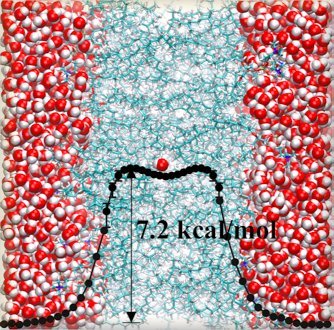
established for small penetrants. For example, the free energy profile of a
single water molecule crossing a lipid membrane can be accurately computed using a
combination of the overlapping distribution method and the cavity-based Widom insertion
method (Figure).
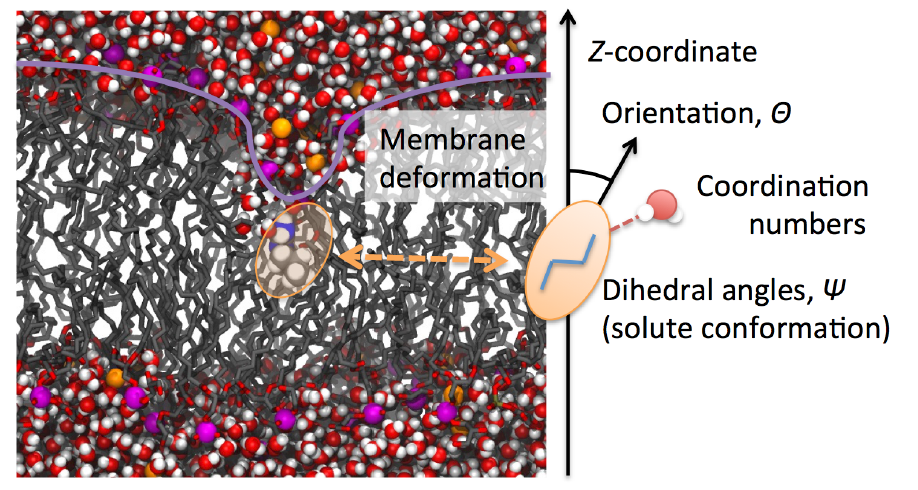
In contrast, computing the free energy profile for larger molecules, such as peptides and nanoparticles, remains a significant challenge.
In these cases, membrane permeation often involves collective dynamics of multiple
molecules, making the choice of appropriate reaction coordinate or collective
variables nontrivial. We are therefore developing simulation methodologies to
elucidate such complex molecular mechanisms. In addition, we are interested in
identifying and quantifying kinetic factors that characterize permeation processes.
An overview of recent progress in permeability assessment using molecular
dynamics simulations is provided in our review article (BBA-Biomembrane,
2016).
 |
 |
| Free energy profile of a water molecule crossing a DPPC membrane
(J. Comp. Chem. 2007) |
Possible slow variables required to characterize the permeation mechanism of large, complex molecules(BBA-Biomembrane, 2016). |
Mechanical Properties of Membranes
Lipid membranes are commonly described using a continuum theory based on the Helfrich Hamiltonian, in which a membrane is modeled as a zero-thickness elastic sheet. The sucess of the continuum theory in characterizing membrane physics at the micrometer scale has motivated us to compute membrane elastic constants directly from molecular dynamics (MD) simulations. By obtaining reliable estimates of elastic constants from MD, we can predict the mesoscopic elastic behavior of vesicles while retaining molecular-level details. Comparison between MD results and experimental measurements of membrane elastic properties also provide a stringent test of the validity of molecular models.
One example of our research in this area is the development of a method to evaluate the free energy of a membrane as a function of imposed curvature (Figure). In addition, pressure profiles across membranes offer an alternative route to determining elastic constants and spontaneous curvature. Recently, pressure profile calculations have been extended to spherical coordinates, enabling their application to spherical vesicle systems.
 |
| Curved membranes supported by the guiding external potential (black circle).
Bending modulus is estimated by the relation between the membrane curvature
and the force required to support the membranes. (J. Chem. Phys. 2013) |