


DDS carrier/
Lipid nanoparticlesMolecular Simulation
Vesicles
Phospholipid molecules can self-assemble into spherically closed bilayers - namely vesicles
or liposomes - among a wide variety of aggregation states in solution.
Such vesicles are widely used as important model systems for biological
cells and also serve as carriers in drug delivery applications.
Our research focuses on understanding the structural requirements for the formation of these supramolecular
containers, as well as other lipid assemblies with varying aggregate curvature. We investigate lipid systems composed of cationic, anionic, and zwitterionic species. Our research acrivities are organized into two main directions:
1. coarse-grained (CG) modeling of lipids interactions, and
2. investigation of vesicle formation processes.
Using CG molecular dynamics simulations, we address the mechanisms of vesicle
formation, vesicle to vesicle interaction and free energy analysis of vesicle-to-bicelle transformation.
 |
| A ~100nm-sized vesicle genrated during a 2μs-CG-MD simulation starting from a randomly aggregated lipid configuration. The system consists of more than 14 million CG particles. This vesicle size is comparable to that of typical drug delivery system (DDS) carriers. |
Lipoplexes
Our research also aims to elucidate the key features of lipoplexes, including their self-assembly processes, membrane evolution, mesoscopic structures, and defect formation. Complexes formed between cationic lipids (CL) and anionic nucleic acids such as DNA are known as “lipoplexes”, which have emerged as highly promising vectors for gene delivery and have been investigated in various clinical phases.
Our initial efforts focus on developing reliable CG models for lipids-nucleic acid interactions. Such models enable a deeper understanding of the self-assembly mechanisms and defect structures of lipoplexes, and the resulting insights can be applied in a task-specific manner to design more efficient and robust gene delivery systems.
 |
 |
| DNA-DOPE-DOTAP complex simulated using AA-MD | DNA-DOPC-DOTAP complex simulated at the CG level using the SPICA force field |
Lipid Nanoparticles
Lipid-based nanoparticles (LNPs) represent a new generation of nucleic acid (DNA/RNA) delivery systems owing to their unique properties, including high drug-loading capacity, efficient release, and low toxicity. Motivated by these advantages, we have extended our force field framework to obtain molecular- and near-atomic-level insights into LNPs, with the goal of designing robust and efficient nanocarriers.
Our studies are primarily conducted using CG-MD simulations, which enable the investigation of complex LNP systems at length and time scales that are often innaccessible to conventional all-atom simulations or experimental techniques. These simulations provide detailed structural information and help elucidate the organization and stability of LNPs, thereby complementing and extending existing experimental observations.
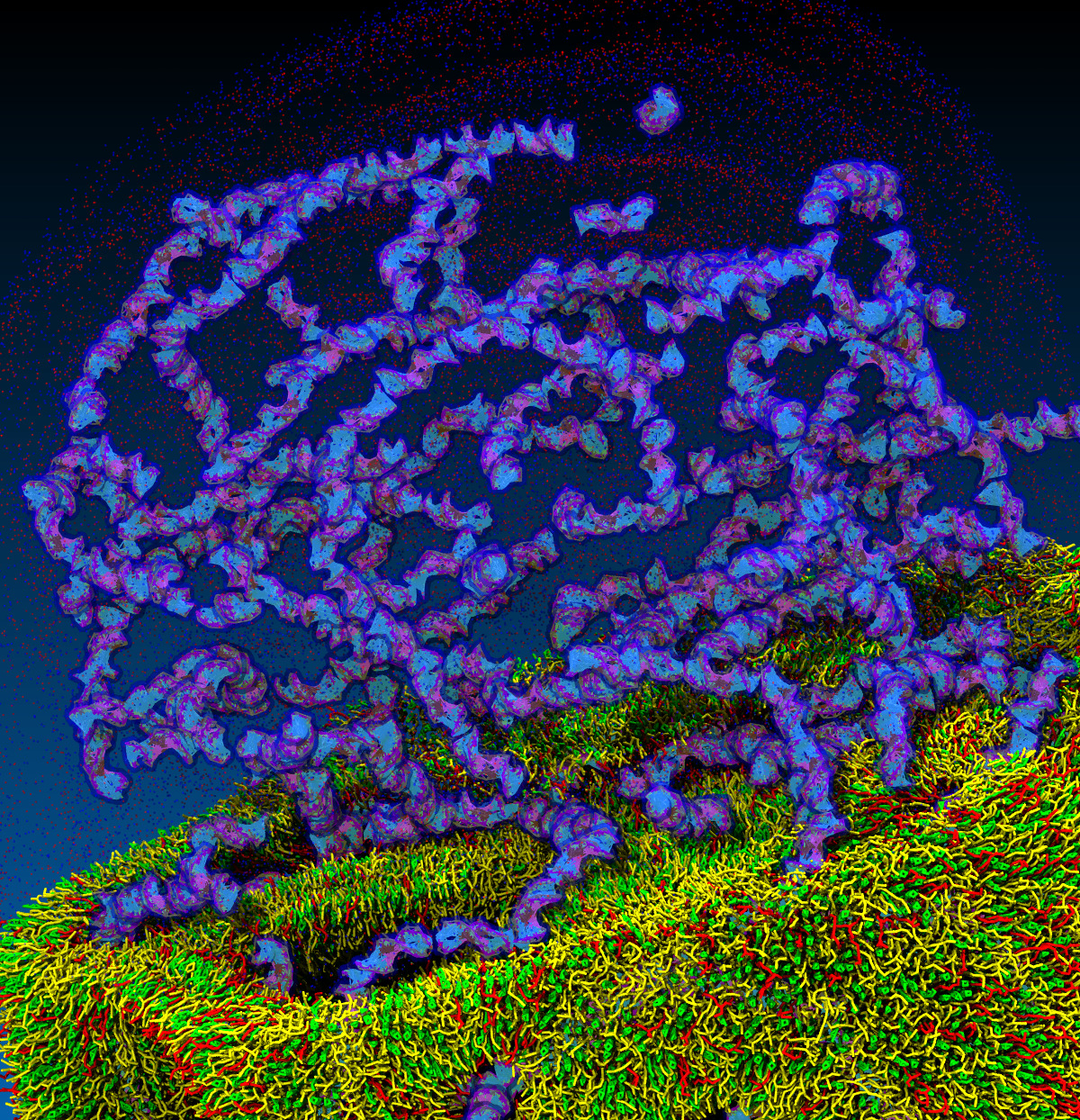 |
| Lipid nanoparticles, vital for next-generation drug delivery, encapsulate dsDNA as shown in the coarse-grained molecular dynamics snapshot. Lipids are partially removed to expose the inner structure, visualized using our advanced SPICA force field-enabling accurate, large-scale modeling of these promising nanocarriers for therapeutic applications. |