


Mass Transport in Heterogeneous Materials
Understanding and predicting macroscopic mass transport from molecular-scale structures and dynamics. (Associate Professor Nagai)
From Local Environments to Macroscopic Transport
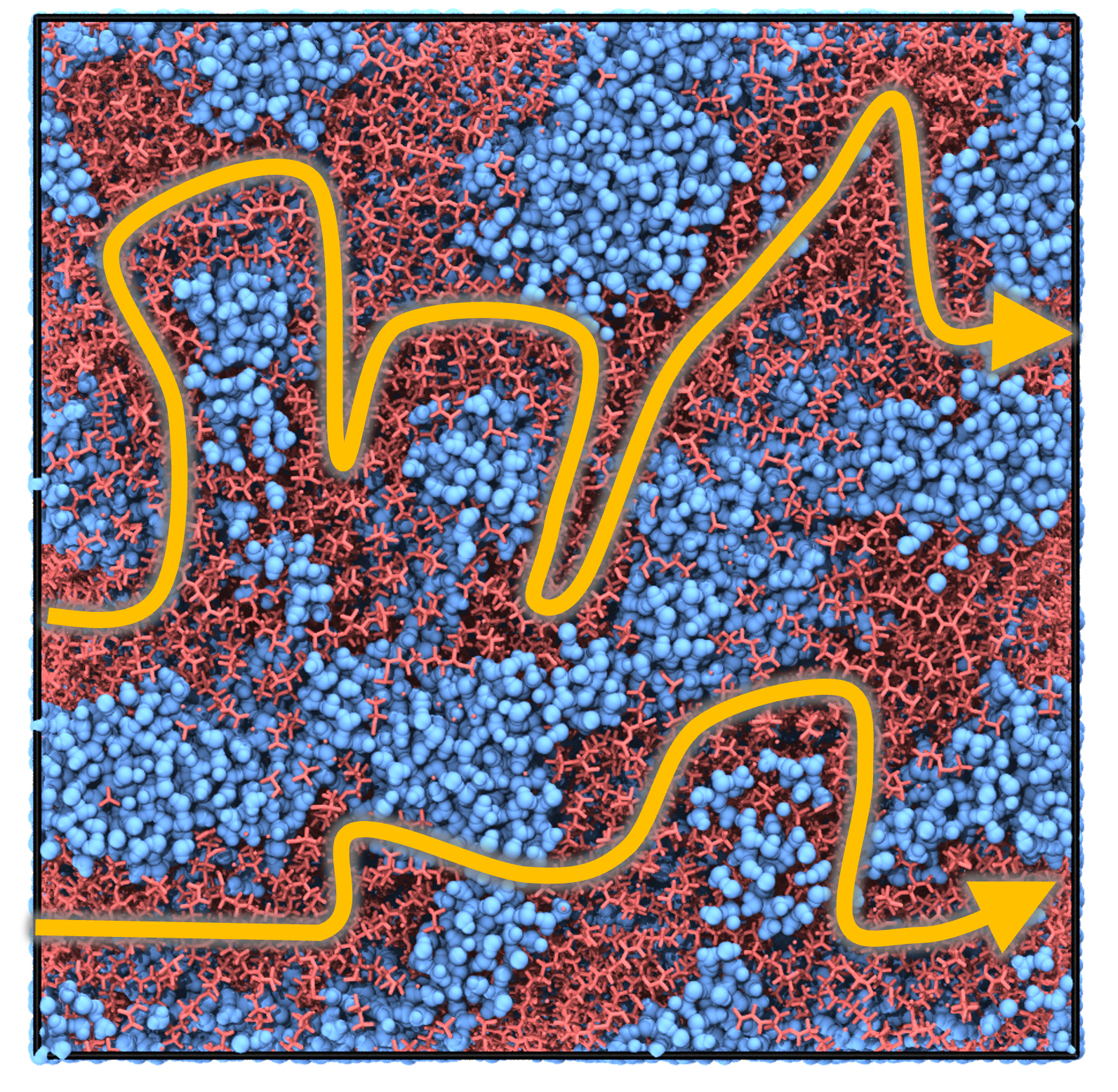
In heterogeneous materials such as polymer electrolyte membranes, local molecular structures and interactions vary spatially, leading to differences in the accessibility and mobility of transported molecules. Understanding mass transport in such systems therefore requires consideration of not only the free-energy landscape but also position-dependent diffusion coefficients. Our research aims to elucidate the molecular mechanisms of mass transport by evaluating these local properties through molecular dynamics (MD) simulations and connecting them to the overall diffusion and permeation properties of materials. We have investigated the free-energy landscapes of hydrogen and oxygen molecules, as well as the long-time diffusion and permeation of hydrogen, in polymer electrolyte membranes for fuel cells[1][2].
Evaluating Position-Dependent Diffusion Coefficients
Understanding transport in heterogeneous materials requires determining how molecular mobility varies with position. However, mean squared displacements evaluated within small spatial regions are affected by the selection of molecular trajectories, making the conventional Einstein relation inapplicable without modification. To address this issue, we developed a method for evaluating local diffusion coefficients using a flat-bottom potential to enhance local sampling while analyzing trajectory segments unaffected by the biasing potential[3]. More recently, we developed another approach that analyzes the nonlinear time dependence of squared displacements averaged within a subspace, further advancing methods for evaluating local diffusion coefficients[4].
Long-Time Mass Transport Using Dynamic Monte Carlo
We developed a dynamic Monte Carlo (DMC) method to simulate molecular motion over long time and length scales using free-energy landscapes and local diffusion coefficients obtained from MD simulations[5]. This method generates particle trajectories consistent with a diffusion equation that incorporates a free-energy landscape and position-dependent diffusion coefficients, enabling the analysis of transport over time and length scales that are difficult to access using conventional MD simulations. Applying this approach to hydrogen diffusion in polymer electrolyte membranes for fuel cells, we obtained permeability values consistent with experimental measurements and identified the polymer phase and the interfaces between the polymer and water phases as the major transport pathways[2].
Extending to Large-Scale Heterogeneous Systems Using Machine Learning
For large heterogeneous materials, evaluating free-energy landscapes and local diffusion coefficients throughout the entire system using MD simulations is computationally demanding. To overcome this limitation, we developed a machine-learning model that predicts these local properties from structural descriptors representing the local distribution of chemical elements. We applied the model to hydrogen diffusion in polymer electrolyte membranes under different hydration conditions and demonstrated that DMC simulations using the predicted local properties accurately reproduce the overall diffusion coefficients[6]. We aim to further extend this approach to larger and more complex heterogeneous materials.
Selected Publications
- Three-dimensional free-energy landscape of hydrogen and oxygen molecules in polymer electrolyte membranes: Insight into diffusion paths
T. Nagai, K. Fujimoto and S. Okazaki. J. Chem. Phys. 156, 044507 (2022).
DOI: 10.1063/5.0075969 - Global diffusion of hydrogen molecules in the heterogeneous structure of polymer electrolytes for fuel cells: Dynamic Monte Carlo combined with molecular dynamics calculations
T. Nagai and S. Okazaki. J. Chem. Phys. 157, 054502 (2022).
DOI: 10.1063/5.0096574 - Position-Dependent Diffusion Constant of Molecules in Heterogeneous Systems as Evaluated by the Local Mean Squared Displacement
T. Nagai, S. Tsurumaki, R. Urano, K. Fujimoto, W. Shinoda and S. Okazaki. J. Chem. Theory Comput. 16, 7239–7254 (2020).
DOI: 10.1021/acs.jctc.0c00448 - Local diffusion analysis using square displacement averaged in subspace
N. Kikkawa, R. Jinnouchi, T. Nagai, S. Okazaki and M. Kimura. J. Chem. Phys. 164, 114105 (2026).
DOI: 10.1063/5.0304592 - Dynamic Monte Carlo calculation generating particle trajectories that satisfy the diffusion equation for heterogeneous systems with a position-dependent diffusion coefficient and free energy
T. Nagai, A. Yoshimori and S. Okazaki. J. Chem. Phys. 156, 154506 (2022).
DOI: 10.1063/5.0086949 - Machine Learning Model to Predict Free-Energy Landscape and Position-Dependent Diffusion Constant to Extend the Scale of Dynamic Monte Carlo Simulations
T. Nagai, N. Kikkawa, R. Jinnouchi, M. Kimura and S. Okazaki. J. Chem. Theory Comput. 21, 2598–2611 (2025).
DOI: 10.1021/acs.jctc.4c01552